English




Why are more and more public places choosing UV sterilization lamp lifting systems?
February 6, 2026
Instruction — what you’ll read in this article
In this article you will learn:
(1) the basic science behind UV-C sterilization and why its effectiveness is strongly distance- and line-of-sight-dependent;
(2) practical limits of ceiling-mounted or floor UV devices (with example dose figures from the literature);
(3) how a UV sterilization lamp lift (a motorized lift that raises/lowers a UV lamp) changes the disinfection equation in public spaces;
(4) safe operating practices and installation tips; and
(5) why many hospitals, transit hubs, libraries and schools are starting to choose lamp lifts as part of their infection-control toolset. Key technical claims are supported with published guidance and studies.
1) Quick primer — how UV germicidal irradiation (UVGI) works
Wavelength matters. Germicidal ultraviolet is in the UV-C band (roughly 200–280 nm). Traditional low-pressure mercury lamps emit strongly at ~254 nm, a wavelength with well-documented microbicidal effect; newer “far-UVC” sources (≈222 nm) are under study for surface and air disinfection.
Disinfection = dose. Efficacy depends on UV dose (irradiance × exposure time), commonly reported in mJ/cm². Different organisms require different doses for the same log-reduction; for example, peer-reviewed studies report that SARS-CoV-2 can be reduced by several log units with doses on the order of single-digit to tens of mJ/cm² depending on wavelength and matrix (air, droplets, or surface). Typical reported values for substantial viral inactivation range from a few mJ/cm² up to ~25–40 mJ/cm² in experimental settings.
2) The practical limits of fixed UV lamps — why “range” is limited
Three physical constraints make fixed UV fixtures a poor one-size-fits-all solution for surface sterilization in public spaces:
Inverse-square fall-off (distance). UV intensity drops roughly with the square of the distance from the source: double the distance, you get ~¼ the intensity. That means a lamp that easily delivers the required dose to items close by may deliver only a tiny fraction of that dose to the floor or far surfaces.
Line-of-sight and shadowing. UV-C disinfects only surfaces it directly illuminates. Furniture, fixtures, curtains, small crevices and even micro-texture create shadows (“canyon wall effect”), hiding pathogens from the beam. This is a fundamental shortcoming for ceiling-mounted lamps trying to disinfect floors, tables or the undersides of objects.
Dose requirements vs. practical coverage. Many commercial UV-C room devices are optimized for near-field or upper-room air disinfection rather than whole-room surface sterilization. To reach effective surface doses (for example, tens of mJ/cm²) at floor or table height from a permanently ceiling-mounted lamp would often require impractically long exposure times or extremely powerful sources, both of which create safety and operational problems. Authoritative guidance (NIOSH/CDC/ASHRAE) therefore treats UVGI system design as a careful engineering exercise, not a “point and forget” fix.
Takeaway: a ceiling-fixed UV lamp can help with airborne pathogen reduction (upper-room UVGI) but is often inefficient for reliably disinfecting ground-level surfaces or furniture; floor units address coverage but consume space and often interfere with use of the room.
3) The key technical numbers (what the literature shows)
Wavelengths: UV-C germicidal action is strongest in 200–280 nm; low-pressure mercury (≈254 nm) is common; far-UVC (≈222 nm) is an emerging alternative that has shown promising virucidal/ bactericidal results in controlled studies.
Representative dose examples: studies report effective virus inactivation at doses ranging from ≈3 mJ/cm² (far-UVC in controlled setups) up to ≈12–25 mJ/cm² or more for robust reductions depending on virus, medium, and wavelength. Surface disinfection recommendations in the UV industry commonly reference doses in the tens of mJ/cm² range to account for realistic surfaces and shadowing. (Dose needs vary—design the system to deliver the required dose at the target surface.)
Practical implication: if your target surface is 2–3 meters below the lamp, expect irradiance to be much lower; you must either increase exposure time, increase lamp power, or shorten the distance to reach the same disinfection level.
4) Why a UV sterilization lamp lift helps — function and advantages
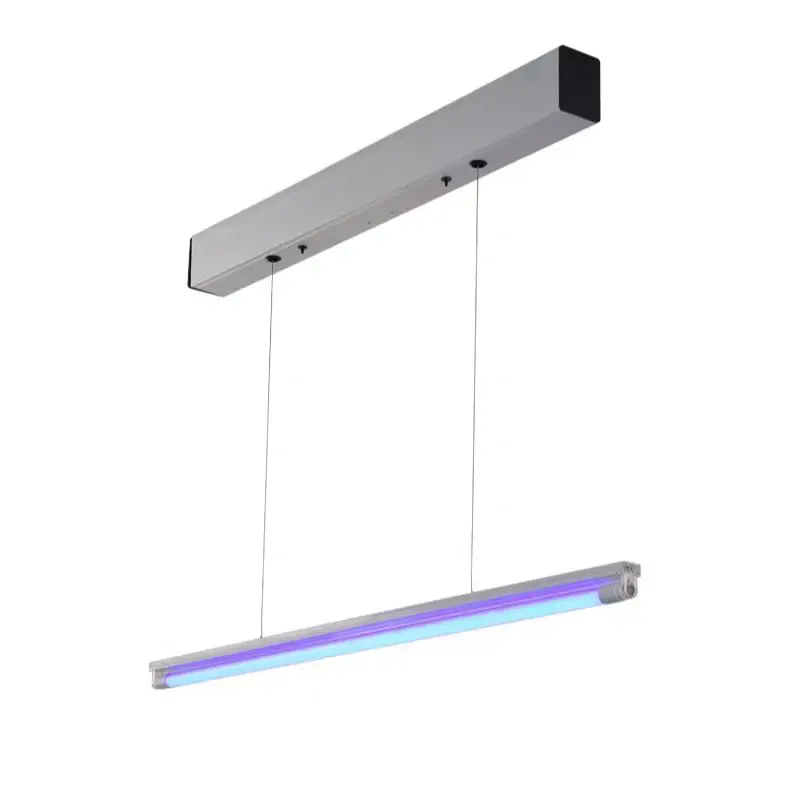
A UV sterilization lamp lift is a motorized hoist that holds the UV lamp and controls its vertical position (and sometimes tilt). The lift typically also controls power to the lamp (interlock) and can be programmed/timed.
How a lamp lift improves real-world disinfection:
- Controlled proximity: instead of relying on a fixed ceiling height, the lamp can be lowered closer to the target surfaces (tables, counters, floors) during unoccupied disinfection cycles, dramatically increasing irradiance at the surface and reducing the time needed to reach a target dose. Because UV intensity follows the inverse square law, small reductions in distance produce large increases in surface dose.
- Line-of-sight management: lowering the lamp for a territory-by-territory pass reduces shadowing problems compared with a single fixed ceiling source. While no system removes all micro-shadowing, lowering and repositioning the lamp makes it possible to irradiate more surfaces with a practical dose.
- Timed / automated cycles: lifts can be programmed to lower only during known unoccupied cleaning windows (overnight or between shifts), run a disinfection cycle, then raise and disconnect the lamp—maintaining aesthetics and protecting occupants from direct UV exposure. This automation reduces human error and helps meet safety requirements.
- Space efficiency: compared to bulky floor towers, a ceiling-mounted lift frees floor space when not in use, preserving functionality of public areas such as waiting rooms, platforms or libraries.
- Net result: the lamp lift converts a ceiling fixture from a limited upper-room/air device into a flexible, targeted surface disinfection tool suitable for scheduled, high-confidence sterilization of surfaces that matter.
5) Typical applications — where lamp lifts make the most sense
Public spaces that combine high throughput with limited downtime benefit most:
- Hospitals and clinics — procedure rooms, isolation rooms, or equipment rooms that can be sealed briefly for scheduled disinfection.
- Transit hubs (rail stations, airport lounges) — rapid night-cycle surface disinfection of high-touch zones while preserving space for passengers during the day.
- Libraries & schools — periodic surface sterilization of reading tables, stacks or lab spaces after hours.
- Large retail or event venues — targeted nightly passes for high-touch counters and VIP areas.
Case studies and field guidance (NIOSH/CDC) show that upper-room UVGI and engineered UV systems are most effective when they are part of a layered infection control plan (ventilation, filtration, cleaning) rather than a single measure. Lamp lifts add targeted surface reach to that layered approach.
6) Why many public-space maintainers are adopting lamp lifts now
- Efficacy + efficiency: by lowering lamps for a scheduled cycle, staff achieve required doses on surfaces in practical timeframes without blocking floor space with towers.
- Aesthetics: lifts conceal the device when not in use; after the cycle lamps retract into the ceiling and the room looks normal.
- Operational control: automated timing, interlocks and integration with building controls give facility managers defensible SOPs for safe disinfection.
- Cost and ROI: compared with frequent manual deep-cleaning or renting portable towers, a permanently installed lift + lamp system can reduce recurring labor and rental costs, especially in high-touch, high-usage facilities.
7) Practical checklist for facility managers considering a lamp-lift solution
1.Decide target surfaces and map required dose at surface level.
2.Measure ceiling heights and verify lift travel (must reach target distance safely).
3.Choose lamp wavelength and power appropriate to your pathogen targets (254 nm or validated 222 nm far-UVC for specific use cases).
4.Require safety interlocks, door sensors and audible warnings for every installation.
5.Plan maintenance: lamp life, radiometer checks, and SOPs for safe daily operation.
6.Integrate lamp lift cycles with cleaning and ventilation schedules (UV is an adjunct, not a replacement for routine cleaning).
8) Hontrix — who we are and why this matters
Hontrix is a manufacturer focused on global light-access solutions. Our Retractable UV sterilization lamp are engineered to integrate controlled lowering, power interlock and automated timing so that facilities can run short, high-dose disinfection cycles safely during unoccupied periods. Our products are used by hospitals, major transit stations, libraries and schools where space, safety and efficacy are equally important. We work with project teams and contractors to size lamps and program exposure cycles that meet facility goals while following recognized UVGI guidance. (If you’d like a technical briefing or specification pack for a specific project, Hontrix can provide dose calculations and site-specific recommendations.)
9) Bottom line — when a UV lamp needs to do more than “hang”
UV-C is a powerful disinfectant, but distance, line-of-sight and dose limit what fixed fixtures can do for floor-level and complex surfaces.
A UV sterilization lamp lift brings the lamp to the target, substantially increasing irradiance and reducing cycle times, while keeping the device out of the way during occupied hours. That combination of effectiveness, safety and space efficiency is why more public facilities are adding lamp lifts to their infection-control toolkit.
Selected references & further reading (authoritative guidance and representative studies)
- NIOSH/CDC. Ultraviolet Germicidal Irradiation (UVGI) Guidelines for Healthcare Settings.
- CDC — surface dosimetry and UV-C implementation notes.
- Peer-reviewed dose studies: Nature / AJIC papers and IUVA summaries on UV-C dose for SARS-CoV-2 and bacteria.
- Technical notes on UV-C effectiveness and line-of-sight limitations (industry primers).